
The short version
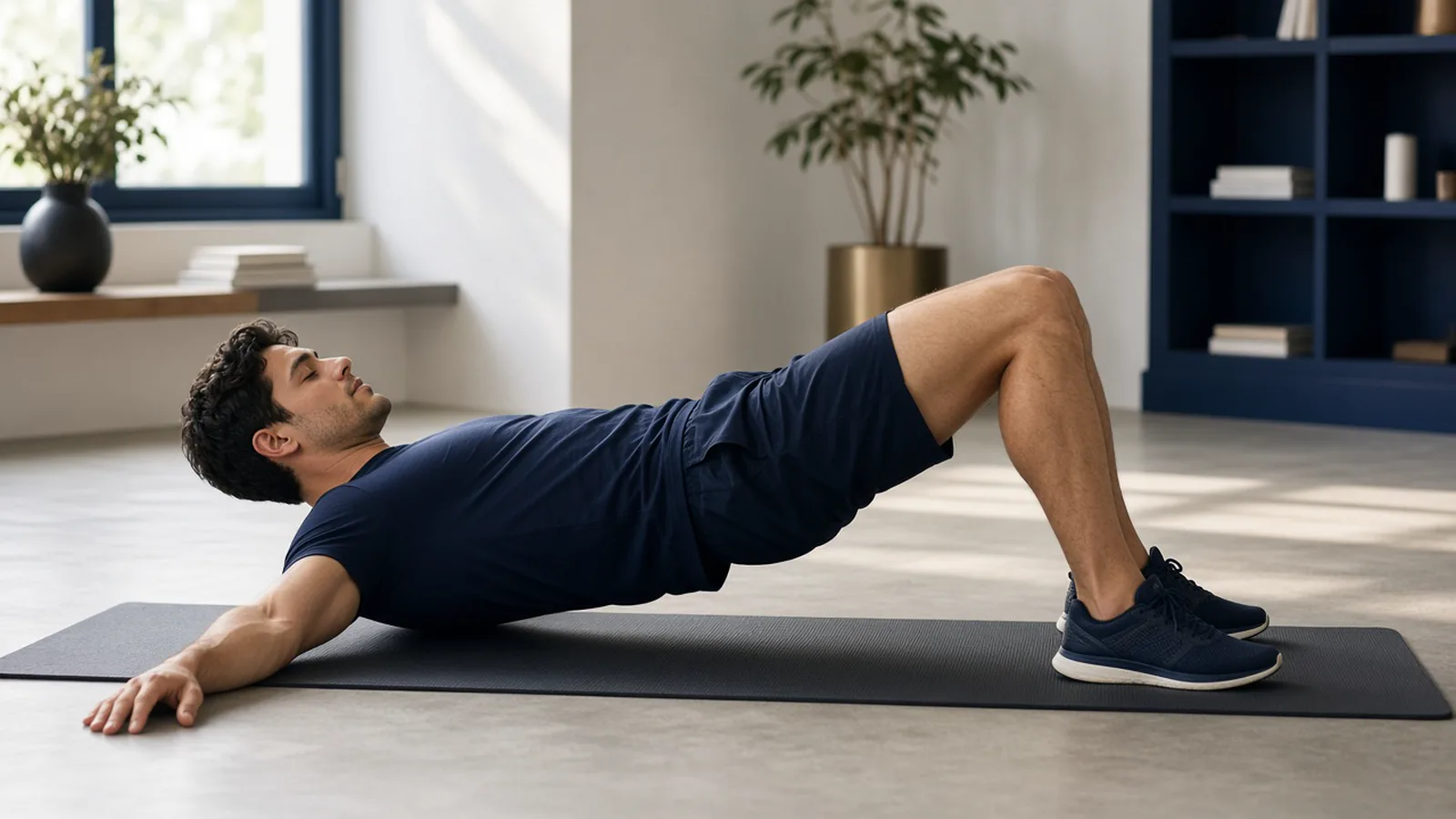
- Lie on your back, feet flat, and lift your hips by squeezing your glutes.
- Stop at a straight line from shoulders to knees. Do not arch your low back.
- Progress to the bridge march, then the single-leg bridge.
The glute bridge trains the muscles that extend your hips, which help you stand, climb and lift. It is gentle on the back and easy to learn, so it shows up in many rehab and conditioning programs.
Progressions
- Bridge hold: hold the top for 10 to 20 seconds.
- Bridge march: at the top, lift one foot a few inches, then the other, keeping hips level.
- Single-leg bridge: one foot on the floor, the other knee pulled toward your chest or leg straight.
Step by step
- Lie on your back with knees bent, feet flat and hip-width apart, heels about a hand’s length from your glutes.
- Press your low back gently toward the floor and brace your stomach.
- Push through your heels and squeeze your glutes to lift your hips.
- Stop when your shoulders, hips and knees form a straight line.
- Pause for 2 seconds, then lower slowly.
Common mistakes and fixes
- Arching the low back at the top. Fix: lift less and keep ribs down.
- Feeling it in hamstrings only. Fix: bring heels a little closer.
- Pushing through toes. Fix: lift your toes slightly and drive through heels.
Do this today
Do 2 sets of 12 glute bridges with a 2-second pause at the top.
Questions people ask
How many glute bridges should I do?
2 to 3 sets of 10 to 15 with a pause at the top is a good start.
Why do I feel it in my back?
Usually from arching. Lift a bit lower and keep your ribs down.
Are bridges good for runners?
They are a common hip-strength exercise in conditioning programs.
Sources
- American College of Sports Medicine. Progression models in resistance training for healthy adults. Med Sci Sports Exerc, 2009. Checked October 9, 2026.
- AAOS OrthoInfo. Hip Conditioning Program. Checked October 9, 2026.
- U.S. Department of Health and Human Services. Physical Activity Guidelines for Americans, 2nd edition (2018). Checked October 9, 2026.
Education only. Not medical advice. Confirm with your clinician.
Free: the 7-Day Starter Plan PDF
One small step a day for a week, plus a printable grocery list. Start here. Learn first.
Get the free PDF