
The short version
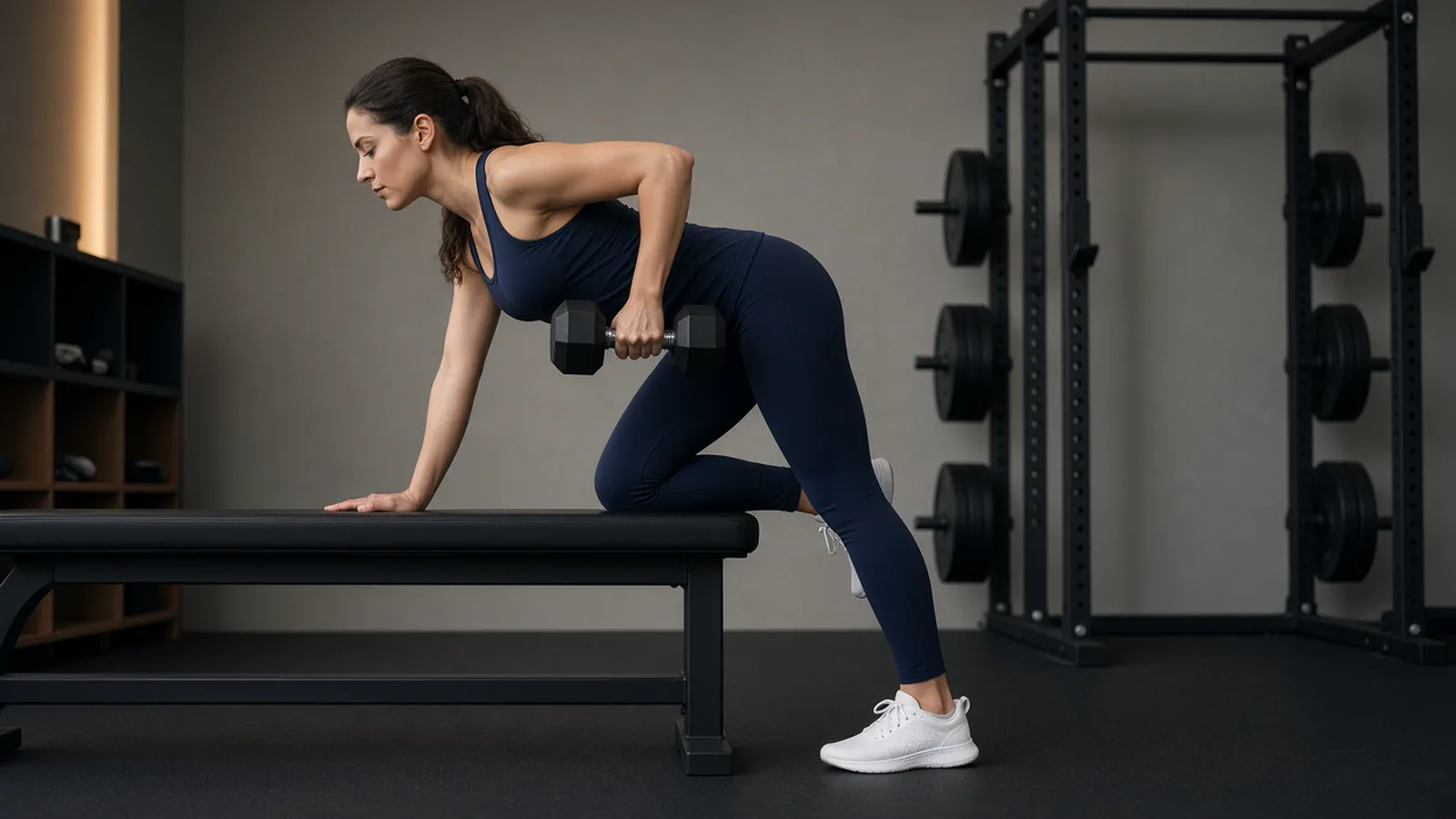
- Support yourself on a bench or chair, back flat, and pull the dumbbell toward your hip.
- Lead with the elbow; keep your shoulders square.
- Rows balance all the pushing you do and build toward pull-ups.
Most daily life is pushing and reaching forward. Rows train the opposite: the upper back and the muscles that pull your shoulders back. They are also a key step toward a pull-up.
No dumbbell?
A loaded backpack or a gallon jug works. Choose a weight you can row 10 times with a pause at the top.
Step by step
- Place your left hand and left knee on a bench or sturdy chair, right foot on the floor.
- Hold a dumbbell in your right hand, arm hanging straight, back flat.
- Pull the dumbbell toward your hip, leading with your elbow.
- Pause and squeeze your shoulder blade toward your spine.
- Lower slowly to a full stretch. Switch sides after your set.
Common mistakes and fixes
- Twisting the torso. Fix: lighter weight, keep shoulders square.
- Shrugging. Fix: pull the elbow back and down.
- Rounded back. Fix: support your weight and keep a flat back.
Do this today
Do 2 sets of 10 rows per arm with a backpack or jug, pausing at the top.
Questions people ask
What muscles does a dumbbell row work?
The upper back (lats, rhomboids, rear shoulders) and the biceps.
How heavy should I row?
Heavy enough that the last 2 reps are hard, with no twisting.
How often?
Two or three strength days a week.
Sources
- American College of Sports Medicine. Progression models in resistance training for healthy adults. Med Sci Sports Exerc, 2009. Checked October 9, 2026.
- U.S. Department of Health and Human Services. Physical Activity Guidelines for Americans, 2nd edition (2018). Checked October 9, 2026.
- NHS. Strength exercises. Checked October 9, 2026.
Education only. Not medical advice. Confirm with your clinician.
Free: the 7-Day Rebuild Plan PDF
One small step a day for a week, plus a printable grocery list. Start here. Learn first.
Get the free PDF